The bottom line
AI marketing is the use of artificial intelligence — generative AI, predictive analytics, and automation — to research audiences, draft content, segment customers, personalize offers, and analyze results. It helps a business decide whom to target, what to say, when to send it, and which channel to use. People stay responsible for accuracy, strategy, and final approval.
- Generative AI creates drafts; predictive AI forecasts behavior. Each needs a different kind of checking.
- Most campaigns use both: predictive AI picks who to reach, generative AI drafts what to say.
- Humans still set prices, approve claims, cap budgets, and decide what not to automate.
- Using AI isn’t the same as getting results from it — start with one workflow and one metric.
This guide breaks AI marketing into concrete tasks, separates the two very different kinds of AI you’ll run into, walks through a hypothetical campaign to show exactly where a person needs to step in, and ends with a short checklist you can use this week.
What AI marketing is
AI marketing means applying machine learning, generative AI, predictive analytics, and automation to everyday marketing work: understanding customers, producing content and ads, personalizing what each customer sees, and improving the decisions behind a campaign. For a business owner, it usually shows up as software that can:
- summarize customer reviews or competitor websites;
- draft an email, ad, or blog post from a short prompt;
- group customers by behavior or likely value;
- adjust an offer or send time for each customer; and
- flag which campaigns or channels are doing well or poorly.
None of this needs a data-science team. Most small businesses already use AI marketing without calling it that. Mailchimp’s Send Time Optimization, for example, uses past engagement data to pick the time within 24 hours of your chosen date when contacts are most likely to open. Google Ads’ Smart Bidding uses AI to set bids for conversions in every auction. And the chatbot on your website may be an AI chatbot too.
How many businesses use AI for marketing
Marketing is where small businesses use AI most. Surveys define “AI use” differently, so read each number with its source:
| Finding | Share | Source |
|---|---|---|
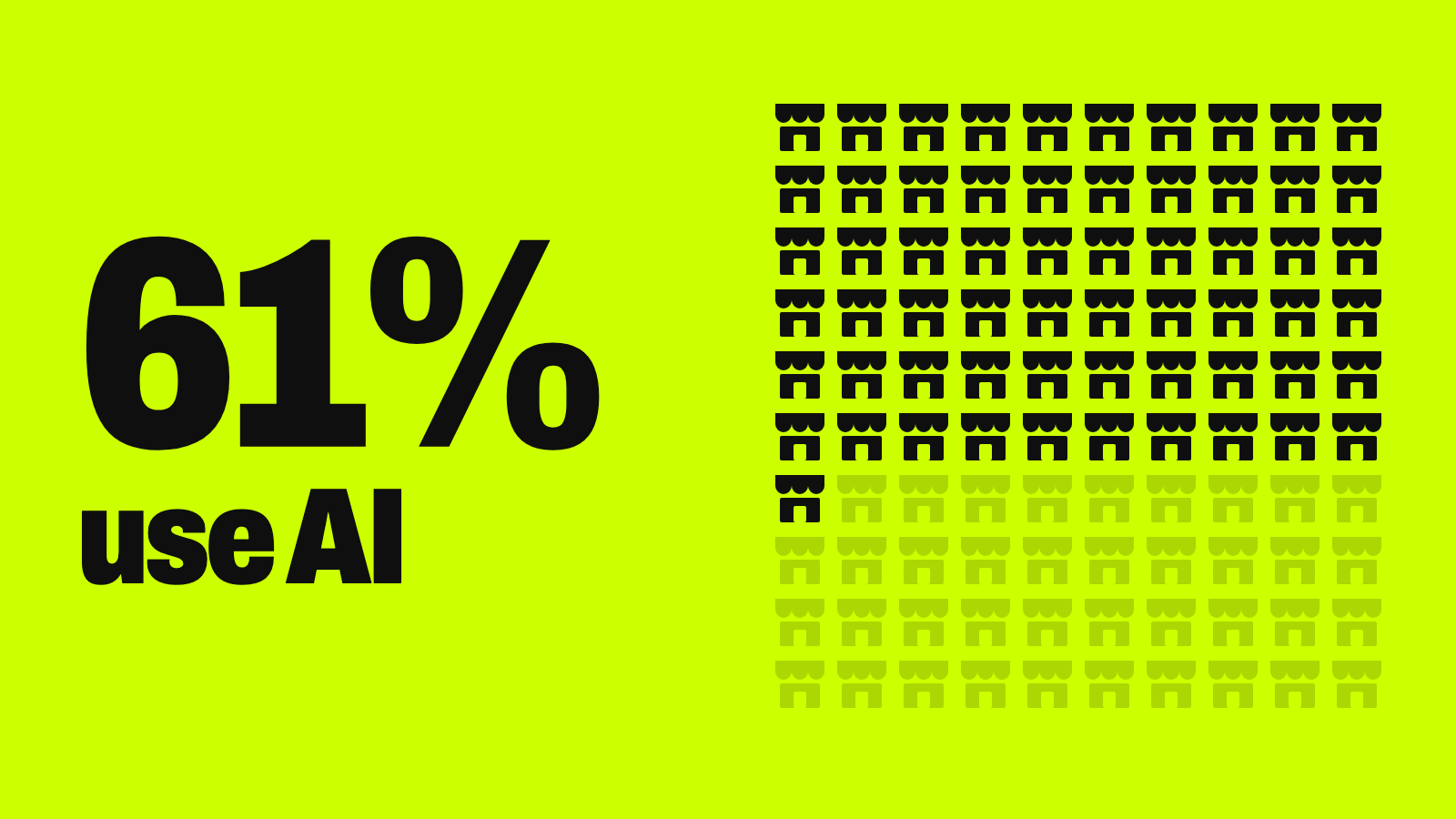
| Small business owners using AI (52% a year earlier) | 61% | OnDeck, Q3 2026 |
| Of those AI users, share using it for marketing — the top use | 62.0% | OnDeck |
| Better marketing performance, among owners who report a positive impact — the top benefit | 39.3% | OnDeck |
| Marketing teams that missed an opportunity last quarter because they couldn’t respond in time | More than 8 in 10 | Adobe, 2026 |
| Marketing teams that have embedded AI in ways that deliver measurable business results | 7% | Adobe |
Two caveats. OnDeck surveyed its own small business borrowers. Adobe surveyed 150 marketing leaders at organizations with at least $100 million in revenue — big companies, but the lesson travels: using AI and getting value from it aren’t the same thing. McKinsey’s 2026 State of AI survey points the same way — marketing and sales are where companies most often report revenue gains from AI, yet only 37% report any profit impact at all.
Generative AI vs. predictive AI in marketing
Most explanations lump everything together. In practice, two different technologies do different jobs, and knowing which one you’re using tells you what to double-check.
Generative AI: drafts and variations
Generative AI produces new content — text, images, audio, video, or code. In marketing, that means blog posts and product descriptions, emails and subject lines, social captions, ad copy, video scripts, design concepts, and replies to customers.
The safe use is drafting and generating variations, not unattended publishing. Salesforce’s own editorial team notes that AI tools can be trained on brand voice-and-tone guidelines “but they can’t pick up on the nuances,” and calls a human edit “absolutely critical.” Treat generative output as a first draft from a fast but inexperienced writer.
Predictive AI: forecasts and scores
Predictive AI analyzes past and current data to estimate what’s likely to happen next: which leads will convert, which customers may stop buying, how much demand to expect, what a customer may buy next, and which audience or campaign will perform best. A retailer, for example, can spot customers who are due for a reorder and send a reminder before they’d normally buy again.
| Generative AI | Predictive AI | |
|---|---|---|
| What it does | Creates new content | Forecasts or scores behavior |
| Main risk | Inaccurate, generic, or off-brand output | Biased or low-quality data |
| What to check | Facts, claims, tone, compliance | Fairness, data accuracy, drift over time |
| Your role | Edit, verify, and approve before publishing | Check the data going in; question odd results |
The five jobs AI does in marketing
- Research. Summarize reviews, scan competitor sites and ads, find recurring complaints, and spot trends across hundreds of posts faster than reading them one by one.
- Drafting. Turn a prompt or outline into a first-pass email, ad, landing page, or social post. Faster production — but it still needs editing for accuracy and voice.
- Segmentation. Group customers by purchase behavior, value, engagement, or likely intent — “frequent buyers,” “at risk,” “high-value prospects” — without sorting a spreadsheet by hand.
- Personalization. Tailor what each group sees: different banners, discount levels, product recommendations, or send times.
- Campaign analysis. Show which touchpoints contributed to a sale, forecast performance, and flag when one ad set is beating another so you can shift budget.
A worked example: one campaign, start to finish
Hypothetical example. A local HVAC company is launching a spring maintenance promotion.
1. AI does the research
The owner asks an AI tool to summarize two years of customer reviews. A theme jumps out: customers don’t know when their system last had a tune-up. A quick competitor scan shows nearby companies charging $99–$149 for spring checkups.
Try this: turn your reviews into marketing messages
This is the research step, and the easiest place to start:
Here are [number] customer reviews for my [type of business], with names and personal details removed: [paste reviews]

1. Group the reviews into the 5–7 themes customers mention most, with a count for each.
2. For each theme, quote one or two short phrases customers actually used.
3. List the three biggest complaints and the three things customers praise most.
4. Suggest three marketing messages that answer the complaints or highlight the praise — in customers' own words where possible.

Only use what's in the reviews. Don't invent statistics, prices, or claims.
2. AI drafts the content
From that research, generative AI drafts three email subject lines, a promotional email, five social captions, and two search ad variations.
3. AI segments and personalizes
A predictive model splits the customer list into “due for maintenance,” “recently serviced,” and “lapsed two-plus years.” Each group gets a different message: a reminder, a loyalty thank-you, and a win-back discount.
4. AI reports results and suggests next steps
A week after launch, the platform reports opens, clicks, and booked appointments by segment, and flags that the win-back offer is converting at half the rate of the others — so the discount or message needs work.
Where the owner made the call
| Decision | What AI provided | What the owner decided |
|---|---|---|
| Price of the offer | Competitor price range | Final price and margin |
| Claims in the ad copy | A draft line: “guaranteed to extend system life” | Cut it — no evidence to back it up |
| Win-back discount | A suggested discount | Approved the discount and set a budget cap |
| Tone of the email | A generic draft | Rewrote it in the company’s voice |
| Compliance | No compliance check | Confirmed advertising and email rules were followed |
| What not to automate | Full automation was technically possible | Kept the final send approval manual |
The cut claim matters. Under federal law, advertising must be truthful, and the FTC’s advertising guide for small businesses says you need evidence for a claim before the ad runs — an AI tool writing the line doesn’t change that. The tools did real work here, but every price, claim, and send decision went through a person before reaching a customer.
AI marketing examples by business type
| Business type | AI marketing examples | Your job |
|---|---|---|
| Local service business | Turn FAQs into local search content; draft ads for emergency services; score inquiries by urgency; send appointment confirmations; predict who’s due for maintenance | Verify service claims, prices, and coverage areas |
| Online store | Draft product descriptions; recommend related products; spot likely cart abandoners; personalize email offers; forecast demand by product and size | Check product accuracy, brand voice, and discount economics |
| Professional services firm | Turn a webinar into an article and social posts; sort leads by industry and need; draft follow-ups after consultations; summarize meeting notes in the CRM | Review regulated, financial, legal, or advisory content before it goes out |
| Restaurant | Predict busy periods; send offers to lapsed customers; draft social posts from the weekly menu; find recurring complaints in reviews | Protect the brand’s personality; confirm menu, allergen, and price details |
| B2B software company | Score accounts by buying intent; personalize landing pages by industry; summarize sales calls; predict renewal risk | Approve claims, protect confidential data, and align with sales (see our prospecting tools review) |
Where AI fits in your marketing plan
AI tools work best inside a written plan, not as a replacement for one. Start by building a one-page marketing plan with AI that sets your goals, audience, and budget; AI then speeds up the work inside that plan instead of producing activity without direction. The same goes for content: if you plan a social media content calendar, AI can draft captions or suggest posting times inside that structure instead of producing disconnected one-off posts.
Limitations and risks of AI marketing
- Made-up facts. Generative tools can invent statistics, features, or policy details that sound right but aren’t. Every claim a customer will see needs a human check.
- Generic, off-brand copy. Unedited AI copy tends to read like everyone else’s.
- Thin content and search. Google’s guidance on generative AI content says using AI to generate many pages without adding value for users may violate its spam policy on scaled content abuse.
- Privacy and permission. Use customer data only in ways you’ve told customers about and have the right to. If you serve customers in the EU, the GDPR applies; in the U.S., check your state’s privacy law and any rules for your industry.
- Email rules still apply. AI-written or not, marketing email must follow CAN-SPAM: a clear way to opt out, honored within 10 business days, and your physical address. The FTC also says you can’t contract away responsibility when another company sends email for you.
- Bias in targeting and scoring. Predictive models can repeat bias in past data. Watch for skewed results in lead scores, pricing, or ad delivery across customer groups.
- Weak measurement. More content doesn’t automatically mean more revenue — remember Adobe’s 7%.
- Over-automation. Automated messages can land at the wrong moment or misread a situation. Complaints, cancellations, and billing questions need an easy path to a person.
Watch out
Don’t paste customer lists, contact details, payment information, or contracts into a general-purpose AI tool. Strip out names and personal details first, or use a business plan whose data terms you’ve checked — our AI cost guide compares what the main business plans include.
How to measure success
Judge AI marketing by business results, not by how much content it produced. Useful measures:
| Metric | What it tells you |
|---|---|
| Conversion rate and cost per qualified lead | Whether the right people are responding |
| Customer acquisition cost (CAC) | What each new customer costs you |
| Return on ad spend (ROAS) | Revenue earned for each dollar of ads |
| Customer lifetime value (CLV) | Whether you’re attracting customers worth keeping |
| Churn and repeat-purchase rate | Whether retention efforts are working |
| Time saved per campaign | Whether the tool frees up real hours |
The simplest test: did this tool improve a meaningful result compared with how you did it before? If the answer is “we produced more content” with no lift in leads, sales, or retention, it isn’t paying for itself yet. And as more visitors arrive from AI assistants, free tools like Microsoft Clarity can show how that traffic behaves on your site.
Key terms
| Term | Meaning | Example |
|---|---|---|
| Generative AI | Produces new text, images, audio, or video | Drafting an email campaign |
| Machine learning | Finds patterns in data to predict or classify | Predicting which leads convert |
| Predictive analytics | Estimates future outcomes from past data | Forecasting demand |
| Personalization | Adapts content to a person or segment | Tailored product recommendations |
| Marketing automation | Runs workflows based on triggers | An abandoned-cart email |
| Customer data platform (CDP) | Unifies customer data from several sources | Combining web, email, and purchase data |
| CRM | Manages prospect and customer interactions | Tracking leads and deals |
| Lead scoring | Ranks how likely a lead is to buy | Flagging high-intent inquiries |
| Customer lifetime value (CLV) | Estimated total value of a customer | Prioritizing retention spend |
| Churn prediction | Estimates who may stop buying | Triggering a retention offer |
| Retrieval-augmented generation (RAG) | Grounds AI answers in your approved information | A chatbot using current policies |
| Marketing mix modeling (MMM) | Estimates each channel’s contribution to results | Comparing search, social, and email |
| Attribution | Assigns credit for a sale to touchpoints | Mapping a customer’s path to purchase |
| AI agent | A system that plans and carries out multistep tasks | Researching prospects and updating the CRM |
Your next step
Start with one workflow this week
- Pick one costly, repetitive task: lead follow-up, repurposing content, reporting, or win-back emails.
- Set one measurable goal — for example, cut lead response time by 30%.
- Clean your data: remove duplicates, fix errors, and confirm you have permission to use it.
- Choose the simplest tool that solves this one problem — often one you already pay for.
- Write approval rules: what AI may draft or recommend, and what needs your sign-off before a customer sees it.
- Run a controlled test against your old process, then review accuracy, fairness, and complaints.
- Scale only after it works, and write the workflow down so your team can repeat it.
Keep going
Business Prompted publishes practical guides, tool reviews, and workflows for people who run businesses. Explore more at businessprompted.com.
Common questions
What is AI marketing?
The use of artificial intelligence — generative AI, predictive analytics, and automation — to research audiences, draft content, segment customers, personalize offers, and analyze campaign results. People stay responsible for accuracy, strategy, and final approval.
Is AI marketing only for large companies?
No. Marketing is the most common use of AI among small businesses that use it. Start narrow — content drafting, review analysis, appointment reminders, or simple segmentation. You need a clear workflow and usable data, not an AI team.
What’s the difference between generative and predictive AI in marketing?
Generative AI creates content — drafts, images, ad copy. Predictive AI forecasts behavior — who’s likely to buy, leave, or respond. Most campaigns combine both.
Will AI replace marketers?
It’s more likely to take over research, drafting, and analysis while people keep responsibility for positioning, creativity, ethics, and accuracy.
Does AI-generated content help SEO?
Not automatically. Google says generating many pages without adding value for users may violate its spam policies. Use AI to support original, expert-reviewed content, not to replace it.
How much customer data do I need?
There’s no universal minimum. A practical starting point is a clean customer list, reliable sales or conversion records, a clear goal, and permission to use the data.
Is AI marketing expensive for a small business?
It ranges from free or low-cost tools — including AI features already built into email and ad platforms — to expensive integrated platforms. Start with what you already pay for.
Can AI make marketing decisions on its own?
It can automate within limits you set, but keep a person approving prices, claims, legal or financial statements, and anything involving sensitive customer data.
Sources & further reading
- Adobe — The State of Marketing in an AI-Driven World (2026)
- McKinsey — The State of AI: Global Survey 2026 (Aug 25, 2026)
- Salesforce — Generative AI in content marketing (editorial guidelines)
- Federal Trade Commission — Advertising FAQ’s: A Guide for Small Business
- Federal Trade Commission — CAN-SPAM Act: A Compliance Guide for Business
- Google Search Central — Using generative AI content
- Mailchimp — Use Send Time Optimization
- Google Ads Help — About Smart Bidding
A note on risk: This guide is general information, not legal advice. Advertising, email, and privacy rules vary by location and industry. Consult a qualified attorney or compliance professional about your situation before making significant changes.
Business Prompted guides are written for practical use and checked against the sources listed above. Read our editorial policy.