The bottom line
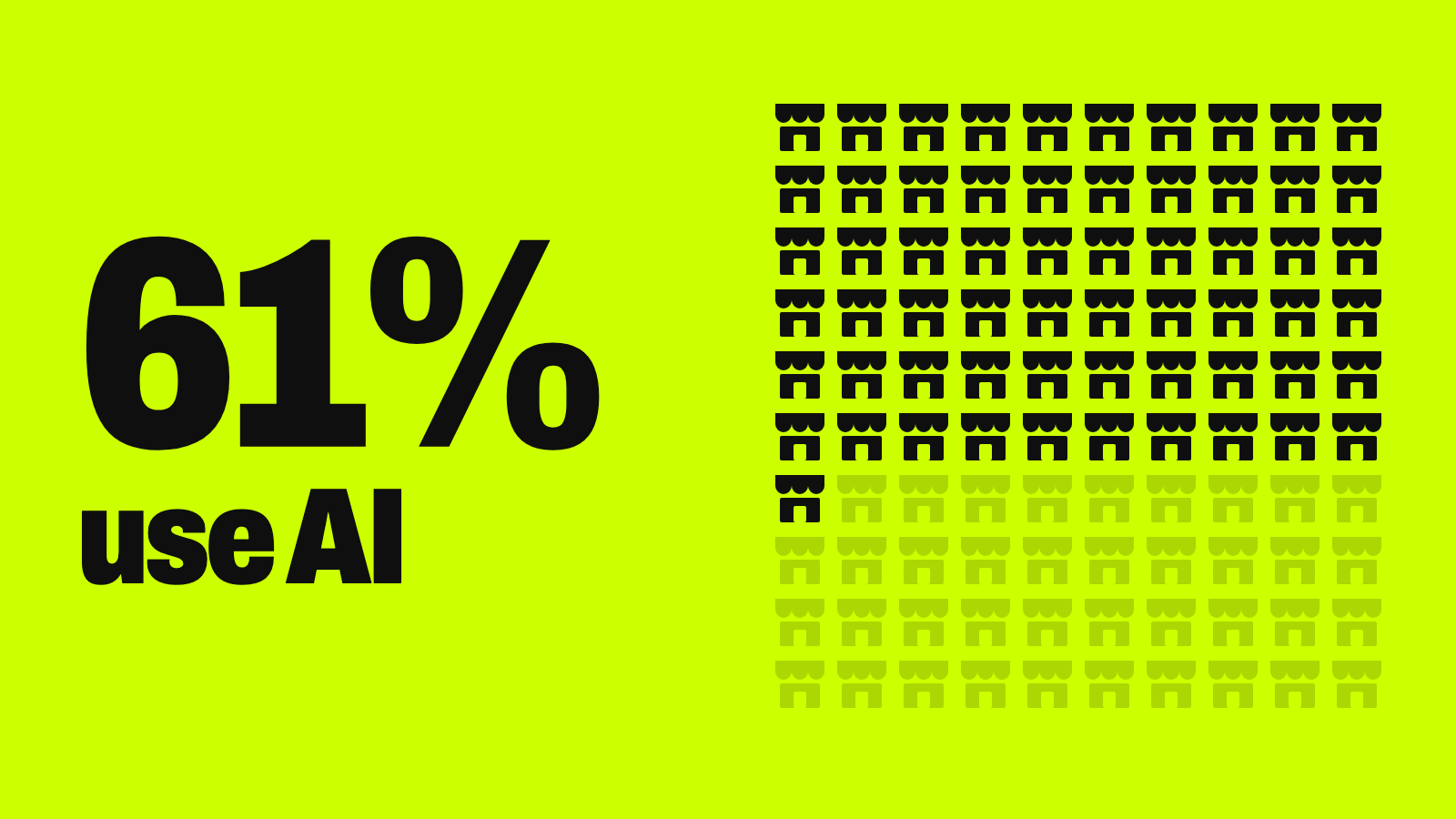
Small business AI use held steady at 61% in the third quarter of 2026, up from 52% a year earlier, according to OnDeck and Ocrolus’s Small Business Cash Flow Trend Report, released November 3. Nine in 10 owners using AI reported a positive impact, most often better marketing performance and fewer errors — each cited by 39% of those seeing a benefit.
- Marketing is the top use by far: 62% of AI users use it for content, emails, and copy.
- Most of the payoff is efficiency, not sales — only 19% of owners seeing a benefit cite increased revenue.
- About a third (33%) plan to spend more on AI in the next six months; 5% plan to cut back.
- The sample is 860 OnDeck borrowers and the impact is self-reported — read it as a signal, not a census.
What the survey found
OnDeck, an online small business lender that’s part of Enova, and Ocrolus, a cash-flow analytics company for lenders, publish the Small Business Cash Flow Trend Report every quarter. This is the 12th edition. It combines a survey of OnDeck customers — mostly firms with fewer than 30 employees and under $10 million in revenue — with cash-flow data from 3.95 million financing applications.
The AI findings show adoption leveling off while the question shifts to results. OnDeck’s own summary: the story is moving “from whether owners use AI to the impact it has on the business.”
Impact figures are shares of owners using AI. Source: OnDeck full results, Q3 2026.
| Measure | Q3 2026 |
|---|---|
| Owners using AI | 61% (same as Q2; 52% a year ago) |
| Significant positive impact | 30.9% |
| Moderate positive impact | 32.6% |
| Slight positive impact | 26.9% |
| No measurable impact | 9.0% |
| Negative impact | 0.6% |
| Plan to increase AI spending (next 6 months) | 32.6% — 62.4% will hold steady, 5.0% will cut back |
How owners are using AI
Among owners who use AI, marketing dominates. Searching for business solutions comes second, ahead of task automation and bookkeeping.
| Use | Share of AI users | Go deeper |
|---|---|---|
| Marketing — content, emails, copy | 62.0% | AI social media calendar |
| Searching for business solutions | 47.2% | — |
| Automating tasks for productivity | 35.3% | What is AI automation? |
| Budgeting and accounting | 25.7% | AI in accounting |
| Chatbots and customer service | 14.6% | What is AI customer service? |
| IT operations and data security | 11.5% | — |
| Hiring and HR | 8.3% | — |
Owners’ write-in answers add detail the checkboxes miss: estimating, quoting, and pricing jobs; drafting and proofreading documents and customer reports; data analysis; product listings and inventory; and research on tax, legal, and technical questions.
Where it’s paying off
Owners who reported a positive impact were asked which measurable benefits they’d seen this year:
Among owners reporting a slight, moderate, or significant positive impact. Multiple answers allowed.
| Benefit | Share citing it |
|---|---|
| Improved marketing performance (e.g., higher conversion rates) | 39.3% |
| Fewer errors or less rework | 39.1% |
| Improved employee productivity | 31.8% |
| Faster customer response times | 27.6% |
| Reduced operating costs | 26.8% |
| Able to operate with fewer staff or avoid new hires | 25.5% |
| Increased revenue | 19.1% |
The pattern matches what we see in practice: AI tends to pay off first in drafting and checking work, and more slowly in direct sales growth. If you’re trying to tell whether it’s paying off for you, our guide to measuring whether AI saves your business money walks through setting a baseline first.
Which industries use AI most
| Industry | AI use | Notable |
|---|---|---|
| Professional, scientific & technical services | 73% | Highest for the fourth straight quarter; 94% report a positive impact; 42% plan to increase AI spending (33% overall) |
| Accommodation & food services | 63% | Second-highest adoption |
| Healthcare & social assistance | 61% | 47% of users seeing a benefit cite fewer errors or less rework |
| Retail trade | Not reported | 49% of users seeing a benefit cite better marketing performance |
| Construction | 51% | Among the lowest adoption, though 96% expect growth — a series high |
| Transportation & warehousing | 47% | Lowest adoption |
Owners are searching with AI, too
The survey also asked how owners look things up. 58.6% said they use AI tools like ChatGPT or Gemini to search for information. Among them, ChatGPT was the most used (82.9%), followed by Gemini (32.7%), Claude (29.2%), Microsoft Copilot (15.3%), Meta AI (6.5%), and Perplexity (4.4%).
When looking for financial service providers specifically, 35.7% use AI search — behind traditional search engines (61.5%) but ahead of comparison sites like NerdWallet or LendingTree (23.3%) and social media (10.1%).
The takeaway goes beyond lending: if business owners are asking AI to find providers, your customers likely are too. Make sure your website, hours, prices, and policies are accurate and easy to read, because that’s what AI tools pull from. Our Shopify Fall ’26 Edition coverage covers how sellers can control the facts AI shopping agents see, and our AI training opt-out explainer covers which AI crawlers can use your content.
How to read these numbers
Watch out
This is a useful signal, not a picture of every small business. The 860 respondents are OnDeck customers with working capital loans, they received an incentive for completing the survey, and the impact is self-reported. OnDeck itself notes it hasn’t verified the responses. And “90% positive” includes the 26.9% who reported only a slight impact — 63.5% reported a moderate or significant one.
Also in the report
- Growth: 93% of owners expect moderate (66%) or significant (27%) growth over the next year, and 68% are on track to meet or beat their 2026 profit plan.
- Concerns: Inflation (36%) is the top challenge, ahead of cash flow (28%), which eased for a second straight quarter, and revenue (17%).
- Financing: 75% of owners went beyond traditional banks for capital.
- Cash cushion: 71% hold at least one month of operating expenses in cash, and median monthly revenue among applicants rose 6% from the second quarter.
Try this: run a 30-day AI test in one area
The two most-cited payoffs were marketing and fewer errors. Pick one and give it a fair, measured test with any AI assistant:
I run a [type of business] with [number] employees. I want to test whether AI actually helps in one area for 30 days: [pick one: marketing emails and social posts / catching errors in invoices, quotes, or orders].

1. Suggest one specific, low-risk task to hand to AI in that area.
2. Tell me what to measure before I start (my baseline) and how to track it each week — for example, time spent, open or click rates, or errors caught.
3. List what I should always check before anything AI-written reaches a customer.
4. Tell me what result after 30 days would mean it's worth keeping, and what would mean I should stop.

Keep it simple enough to track in a spreadsheet. Don't assume or invent results — I'll supply my real numbers.
Your next step
What to do with these numbers
- If you haven’t started, begin where peers report the most payoff: marketing drafts or error-checking.
- Write down a baseline before you start, so “positive impact” is something you can actually measure.
- Review anything AI drafts before it reaches a customer.
- Check that your website and listings are accurate — more people are finding businesses through AI.
- Free training is available: Goldman Sachs’ Small Business AI Institute is one option.
Keep going
Business Prompted publishes practical guides, tool reviews, and workflows for people who run businesses. Explore more at businessprompted.com.
Common questions
What percentage of small businesses use AI?
In OnDeck and Ocrolus’s Q3 2026 survey of 860 of OnDeck’s small business customers, 61% said they use AI — unchanged from Q2 and up from 52% a year earlier. Other surveys use different samples and definitions, so their figures vary.
What do small businesses use AI for most?
Marketing, by a wide margin: 62% of AI users use it for content, emails, and copy. Next come searching for business solutions (47.2%), automating tasks (35.3%), and budgeting and accounting (25.7%).
Is AI paying off for small businesses?
Most users say so: 90% reported a positive impact, though 26.9% called it slight. About 63.5% reported a moderate or significant impact, and 0.6% reported a negative one. These are self-reported results.
What benefits do small businesses get from AI?
The most-cited were improved marketing performance (39.3%) and fewer errors or less rework (39.1%), followed by employee productivity (31.8%). Increased revenue was cited least (19.1%).
Which industries use AI the most?
Professional, scientific, and technical services led at 73% for the fourth straight quarter. Transportation and warehousing (47%) and construction (51%) had the lowest adoption.
Are small businesses planning to spend more on AI?
32.6% plan to increase AI investment over the next six months, 62.4% plan to maintain it, and 5.0% plan to decrease it.
Who publishes the Small Business Cash Flow Trend Report?
OnDeck, a small business lender owned by Enova International, and Ocrolus, a cash-flow analytics platform for lenders. The Q3 2026 survey ran September 16–28, 2026, and the report was released November 3.
Sources & further reading
Business Prompted guides are written for practical use and checked against the sources listed above. Read our editorial policy.